The fastest RC cars in the world

Thursday, August 31, 2006

Telecrapper 2000 Telemarketer Interception System


It's an open source software that you can install on your computer to trap telemarketers in an endless loop on your computer and then record the results. Here's an amusing Flash animation reenactment of the Telecrapper 2000 in action.

Video: Successful sustained flight of manned bird-like flapping-wing ornithopter aircraft

By Justin Wastnage

The Canadian team behind the first sustained flight of an ornithopter flapping wings-powered aircraft believes the prospect of a manned craft is now real, despite video evidence showing the experimental craft suffered a buckled trailing-edge in the attempt.

The University of Toronto Institute for Aerospace Studies has been working on the piloted Ornithopter concept since the early 1990s, with a proof of concept accelerating to rotation speed in 1999. The ornithopter (C-GPTR) performed its first sustained flight on 8 July on the final of three test runs. Once the aircraft reached forward speed of around 43kt (80km/h) the wings were given maximum throttle, flapping at a rate of 1Hz, lifting the aircraft off the runway at Toronto Downsview airport for 10s of straight and level flight at 48kt.

The ornithopter reached an altitude of around 1m (3ft 3in) and flew for around 330m (1,100ft) before the pilot Jack Sanderson thought he had hit cross wing and throttled back to bring the aircraft down. The team has since concluded that the trailing-edge section of the left wing buckled, caused by the flight loads coupled with the flapping loads. The aileron-less aircraft's left wing touched the tarmac, leading the ornithopter to tip, spin around and collapse the nose gear.

The aircraft had a maximum take-off weight of 350kg (770lb), but the team estimates the wing could have lifted only 270kg before bucking.

James DeLaurier, the researcher leading the ornithopter project says the flight, which lasted a total of 14s has crossed a psychological barrier regarding the feasibility of a full-scale flapping-wing aircraft. "The flapper's few seconds of sustained flight brings the notion [of human-carrying ornithopters] into the realm of reality," he says.

The project is now looking for funding to build a new wing optimised for the actual aircraft weight. If this is not found, the ornithopter will be rebuilt for the Toronto Aerospace Museum.

Wednesday, August 30, 2006

Early peek at Vista pricing shows big spread

From Arstechnica:
We know about Vista's many editions, but the pricing has been something of a mystery. Over the weekend, Microsoft Canada accidentally leaked details about Vista's Canadian pricing. Now Amazon has published a list of the US prices for the various Vista editions, along with a release date of January 30, 2007.

Here's the skinny on the pricing from Amazon. Keep in mind that pricing and release date are subject to change; in fact, a Microsoft spokesperson told Ars that the pricing is not set in stone.

Full versions:

Windows Vista Home Basic: $199
Windows Vista Home Premium: $239
Windows Vista Business: $299
Windows Vista Ultimate: $399

Upgrade versions:

Windows Vista Home Basic Upgrade: $99.95
Windows Vista Home Premium Upgrade: $159
Windows Vista Business Upgrade: $199
Windows Vista Ultimate Upgrade: $359

Trials of Boeing ATM concept begin in San Francisco

During a Tailored Arrival, integrated datalink technologies establish a four-dimensional flight profile between an air traffic control facility and the flight deck of an approaching aircraft when it’s ready to begin its descent, about 140 miles away from final destination. The flight crew uses the auto-load function to transfer the optimized trajectory into the aircraft’s Flight Management System, and the FMS flies the given trajectory to touchdown in an efficient, predictable, continuous descent. (Boeing graphic)

From Boeing News:

By Daryl Stephenson

Operational trials of Boeing Tailored Arrivals, a new Air Traffic Management concept, have begun in the San Francisco area.

These are the latest in a series of such studies by Boeing that show that Tailored Arrivals can increase airspace capacity; maintain schedule integrity; reduce fuel consumption, emissions and noise; and ease the workloads of controllers and pilots.

The first of nearly 20 flights in the trials – on a United Airlines Boeing 777-200 – arrived at San Francisco International Airport Aug. 17. The aircraft received a clearance that stretched from its oceanic control sector all the way to its arrival runway. Clearance delivery took advantage of the U.S. Federal Aviation Administration's new Ocean 21 system, which uses the FANS-1/A integrated datalink system.

Through Tuesday, nine flights had been conducted with United Airlines 777 airplanes, said Rob Mead, Phantom Works lead engineer for Advanced Air Traffic Management Air/Ground communications.

Boeing is under contract with NASA's Ames Research Center and working with the U.S. Federal Aviation Administration and United to conduct the trials, which are evaluating Tailored Arrivals approaches from the ocean.

"Our studies of Tailored Arrivals around the world are showing that this concept enables airlines to operate more efficiently," Mead said. "As they fly these optimized profiles, aircraft operators can more fully utilize the capabilities of their aircraft to significantly reduce noise and environmental impact around airports as well as reduce their fuel costs." Tailored Arrivals also enable pilots to fly airplanes as they were designed to be flown, which helps reduce crew workload and errors, he said.

During a Tailored Arrival, datalink technologies establish a four-dimensional flight profile between an air traffic control facility and the flight deck of an approaching aircraft when it's ready to begin its descent, about 140 miles away from final destination.

The flight crew uses the auto-load function to transfer the profile into the aircraft's Flight Management System for review. Once the crew accepts the profile and confirms they will fly it, the FMS flies the given trajectory to touchdown with considerable accuracy.

Rather than a traditional vectored, step-down approach in which pilots must abandon the aircraft's built-in automation, the Tailored Arrivals profile is an efficient, predictable, continuous descent. Both airborne and ground systems have the same descent plan, and pilots and controllers have minimal need for voice communication as they make maximum use of modern aircraft capabilities.

An important objective of the San Francisco trials is to validate capabilities of NASA's Enroute Descent Adviser, which computes fuel-efficient descent solutions when there are complex traffic constraints and airspace restrictions. Specifically, the trials are examining the EDA's ability to predict trajectories and make adjustments to flight profiles and arrival times, and to coordinate and execute these trajectories across multiple air traffic control sectors and facilities. In order to make trajectory predictions more accurate, current cruise and descent wind forecasts available to air traffic control are being uplinked to aircraft flight decks.

San Francisco is one of three locations where operational trials of the Boeing Tailored Arrivals concept have been conducted over the past two years. The others have been in Australia and in the Netherlands.

From April to September 2004, Boeing worked with the Air Traffic Alliance (a grouping of European Aeronautics Defence & Space Co., Airbus and Thales), Australian air carrier Qantas and air navigation services provider Airservices Australia to conduct trials of Tailored Arrivals in Sydney and Melbourne, Australia.

Results from more than 70 flights showed actual arrival times were as little as two seconds and never more than 30 seconds off of predictions made 40 minutes in advance. Voice communications were nearly eliminated. Flight and simulation data showed potential fuel savings from 400 pounds (180 kilograms) to 800 pounds (360 kg) per flight.

A second set of trials in Australia is planned for later this year. These trials are to include a demonstration of automatic detection of aircraft that fail to meet their negotiated estimated times of arrival or otherwise deviate from the profile cleared by the ground system. Quickly detecting aircraft that are "off plan" is essential if controllers are to maintain situational awareness as they transition from tactical to strategic control.

From January to March 2006, Boeing worked with the Dutch air traffic control agency Luchtverkeersleiding Nederland, Eurocontrol-Maastricht air navigation service providers and two Dutch airlines (Transavia.com and Martinair Holland) to conduct more than 190 flights at night to evaluate continuous descent arrivals at Schiphol Airport in Amsterdam, the Netherlands.

Data showed more accurate predictions of air traffic behavior for pilots and controllers, reduced noise and emissions, and fuel savings from 442 pounds (200 kg) to 884 pounds (400 kg) per flight. The trials also identified areas of air/ground data sharing that can improve predictions of arrival times and arrival paths. Such information is critical to design new ground systems and procedures for fuel- and noise-efficient continuous descent arrivals to be flown in more congested periods.

The Boeing Tailored Arrivals concept represents a significant step toward ATM solutions that can be part of the U.S. Next-Generation Air Transportation System and the Single European Sky ATM Research program, said Kevin Brown, Boeing Phantom Works vice president and general manager of Advanced ATM.

"Our work in this area stems from a strong commitment to global interoperability," Brown said. "We are working toward a global ATM system that leverages shared precision information to ensure efficient, safe operations."

Tuesday, August 29, 2006

Wi-Fi Alliance to test and certify 802.11n Draft 2.0 equipment

From Arstechnica:
In an unusual move, the Wi-Fi Alliance will certify the next generation of wireless networking equipment in two waves. The two-step process is designed to give consumers access to the latest technology now with some confidence of interoperability, and to give the IEEE some breathing room to finalize the specifications on its own schedule.

The first phase will be based on draft 2.0 of the standard, to be released this coming March, and certified equipment will have been thoroughly tested to ensure that it works with other certified 802.11n pre-standard gear. The second phase will certify equpment against the full, final version of the IEEE standard, and is expected sometime in the first half of 2008.

The Wi-Fi Alliance, which includes industry heavyweights like Intel, Motorola, Cisco, and Texas Instruments, recognized a need for quick action in response to the heavy demand on faster wireless networking equipment. All of the major networking specialists, including Linksys, Netgear, and D-Link, already have products on store shelves based on draft 1.0 of the 802.11n standard, and millions of units are expected to ship in 2007. The problem with that is interoperability, as some parts of the draft are open to some interpretation, making routers from manufacturer A less than guaranteed to work with access cards from manufacturer B today. Forcing manufacturers to submit to interoperability testing should eliminate that concern.

The two stages of certification will carry clearly different brandings, though no names or images have been chosen yet. Phase one gear will also be clearly marked as not guaranteed to be forward-compatible with phase two, in order to cut down on customer confusion and the nearly inevitable lawsuits that would result from leading us to believe that everything will work perfectly with final stage equipment.

Now, stage two will be backwards-compatible, but there's just no guarantee that missing features in phase one will be available through firmware or driver updates. Chipset makers and networking equipment manufacturers from Atheros and Airgo to Netgear and Dell are supporting the two-stage approach, and Intel plans to support 802.11n in its first phase of certification in its Kedron wireless module for Santa Rosa, the next generation of the Centrino mobile platform. If the IEEE does not produce its next draft by next spring as expected, the Alliance will take it upon itself to pull together the next best thing—a coherent set of de facto standards.

Digital Camera that makes you thinner

Hewlett-Packard's Design Gallery software offers a "Slimming Mode" that makes the object in the center of the photo appear longer and leaner. Credit: Hewlett-Packard

From Cnet:
Want to look thinner? Taller? Tanner? Don't worry, there's a camera for all that.

Today's cameras will let you do more than adjust the flash; they'll let you adjust reality. Photo-adjusting features that once required a PC and special know-how are now allowing consumers to alter a photo as soon as it's snapped.

Some new Hewlett-Packard cameras include a feature that makes subjects look thinner, while another mode makes facial lines and pores virtually disappear. A "skin tone" feature on some Olympus models can give consumers a leisure-class tan. Other manufacturers offer modes to make the colors of the world richer as you capture them. Using these new in-camera tools, consumers can even crop out ex-boyfriends, or put a virtual frame around a new one.

What's new:

Some cameras now come with features that make subjects look thinner or decrease the look of facial lines, while other in-camera tools can make landscapes richer.

Bottom line:

The changes in photography may make consumers more comfortable with the way they appear in pictures, but some critics say they could also undermine people's ability to believe in photographs' integrity.

Monday, August 28, 2006

Corsair introduces 1111 MHz "Dominator" memory

From TomsHardware:
Forget 1 GHz memory, 1111 MHz is what you need. In what appears to be an accelerating race between performance memory manufacturers, Corsair has taken the lead. The company today announced its "DHX XMS2 Dominator memory series," which includes the first PC2-8888 memory. The modules are clocked at 1111 MHz at CAS 4 settings. Corsair also offers a "regular" and "lower-cost" PC2-8500 (1066 MHz, CL-5) version of the new memory.

Corsair claims that its new Dual-path Heat Xchange (DHX) of the memory devices is the "most advanced" thermal dissipation technology that allows RAM to run at lower temperatures - or higher clock speeds for that reason. In fact, the company believes that DHX is so effective that it guarantees "module reliability at over 2.5 volts (2.4 volts, +/- 5%) when combined with Corsair's new "Airflow" fan"

New technologies aren't cheap and Corsair's Dominator memory is not an exception. Expect to pay between $380 and $400 for the 1066 MHz version in a 2 GB pack and between $600 and $650 for the 1111 MHz memory (2 x 1 GB). The Dominator Airflow fan will be offered for about $25.

New York to L.A. in Two Hours

From Wired:
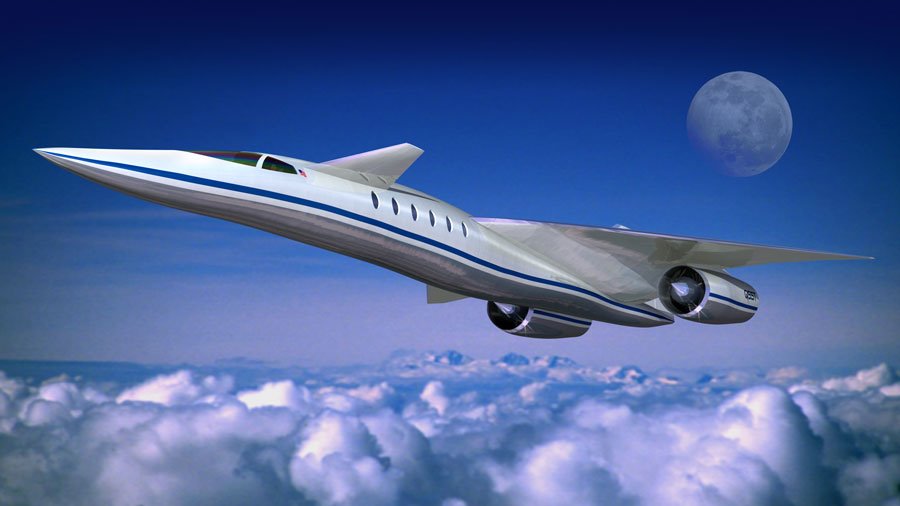
A new generation of private jets could trigger a boom in luxury supersonic flight -- without the sonic boom. Flying at up to Mach 1.8, these luxurious private jets would cut the travel time between Seattle and Tokyo to about 5 hours, instead of 9.5 hours.

General Electric, Pratt & Whitney and Rolls-Royce have submitted designs for the QSST engine that suppress take-off and landing noise, according to backer Supersonic Aerospace International of Nevada. The company was started by Gulfstream founder Allen Paulson's son J. Michael Paulson in 2000 and claims 22 patents on the aircraft. Rendering Courtesy: Supersonic Aerospace International

Video: Charlie Rose Interviews Conan O'Brien.

Saturday, August 26, 2006

AMD and Intel dual-core prices falling

From TomsHardware:
They did this last Friday, too: Prices for AMD dual-core processors are taking another pre-weekend dip, according to the latest data from PriceGrabber, with the Athlon 64 X2 5000+ falling the furthest since Monday: down $47 (13.1%) to $313. The trouble for AMD is, Intel prices are continuing to fall at the high end.

In our latest CPU price/performance chart, Intel Core 2 Extreme prices have fallen $71 since Monday, down 6.0% to an average of $1,111. Core 2 Duo prices are following nicely, with the E6400 price down 3.6% over Monday to $238, and the E6300 price down 4.9% to an all-time low of $194.

On our estimated CPU price/performance scale, the Athlon 64 X2 5000+ extends its lead as AMD's best price/performer overall, with a plot point that falls nearest to the bottom right corner of the chart. At an average street price of $313, a hypothetical Intel processor with a performance index score of 2.72 would sell for $478.84, assuming all Intel processors were averaged out along the curve.

Friday, August 25, 2006

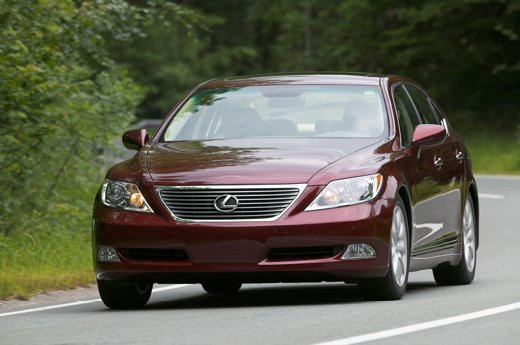
Video: Self-Parking Lexus LS 460 L


Here's how it works.

1. You drive past a parking spot at 12 mph or less. The four rear and six front sonar sensors detect the cars, and the gap between them.

2. Putting the car into reverse activates the wide angle backup camera. There's a little button on the bottom of the screen that looks like a car parking. Hit it. If the spot is more than 6 and a half feet longer than the car itself, the car enters Advanced Parking Guidance System mode. This is where the magic happens.

3. Crawl backwards, keeping your foot on the brake. If you touch the gas, or the wheel, the mode shuts itself off. Make sure to stay under 2.5 mph, or it'll shut off, too. The wheel, as you can see from the video above, spins itself like its being ghost driven. The sonar system is constantly measuring distance, beeping with more urgency as you get closer to obstacles.

4. When you're in the spot, the computer will announce that parking is complete.

Carbon Fiber Boat Stabs Through Waves


From Gizmodo:
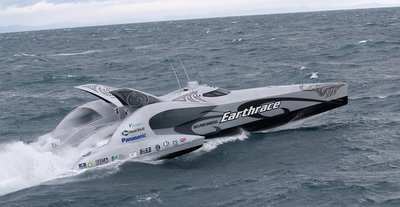
The Earthrace boat isn't some Greenpeace sponsored, treehugging tug. No! It's a treehugging, carbon/Kevlar-hulled, 1080-Horsepower, 78 foot speedboat with a sharp bow meant to harpoon waves. Apparently, submarining through the crests of waves is a lot more efficient than going up and over them. And, as Wired reported, the boat ran a section of its circumnavigation off biofuel processed from the captain's ass fat. Really.

Thursday, August 24, 2006

Absolutely sick. Need 2000 hp to go to the store?


There are some misguided folks out there who think that big displacement and technology are somehow mutually exclusive. And then there's Tom Nelson of Nelson Racing Engines. His Project F Bomb engine (a twin-turbo 408 cubic inch small-block Chevy that threw down an evil 1480 HP and 1440 lb-ft) recently graced the cover of Hot Rod magazine, and he has plenty of other fine examples showing his ability to build huge power via forced induction.

The video above shows what happens when 522 cubes of big-block Chevy are subjected to 10 PSI or so of boost and stuffed into a classic Pontiac LeMans. We're going to warn our readers that a bit of rowdy driving occurs past the half-way point, so if you're easy upset by hot-testing a rev limiter on public streets, it's probably best to skip to the next post. On the other hand, if you want to see what happens when 1000 HP is applied in 3rd gear at 20 MPH, by all means roll the clip and prepare to receive some goose bumps. Polite words fail to accurately describe such a diabolic creation. Note, too, just how mild mannered this thing is when driving at sane speeds.

Of course, the best feature about such a setup is its adjustability. It can be knocked down to a mere 1000 HP or so for taking trips to the grocery store on pump gas, and then cranked up towards 2000 HP on racing fuel - if, indeed, the rest of your car (and your guardian angel) can handle that sort of power.

[Source: Nelson Racing Engines; a hat tip to JV]

WEINECK COBRA

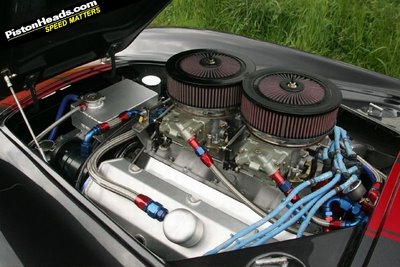
It boasts 12.9 litres (780ci) of bespoke big block American V8 fed by a pair of the biggest Holley carburettors you have ever seen creates 1,100bhp at 7,000rpm with a stonking 1,299lb-ft of torque to propel a car weighing just 1,000kg.

Video: A flock of birds ingested in airplane engine


Video footage has been released of an Airbus A330-200 beloging to Swedish charter carrier Novair suffering a birdstrike last week.

A passenger onboard the A330 was filming the right hand wing on climb-out from Sarafovo airport near the Black Sea resort of Burgas in Bulgaria last Friday en route to Stockholm Arlanda when the aircraft flew through a flock of storks. Several of the birds were ingested into the engine, as the video from Swedish newspaper Expressen shows.

The aircraft continued its flight and landed safely with only minor damage to the wing.

First on-chip cooling system?

From ZDnet:
Researchers at the University of Washington (UW) have developed a cooling device small enough to fit on a computer chip. This tiny ion pump uses an electrical charge 'rather than liquid or fans to create a cooling air jet right at the surface of the chip.' This research project looks so promising that even a company like Intel has been involved in it. But if there is a working prototype today, don't expect to work with a silent computer anytime soon. But read more…

Apparently, the idea is not new, but it's the first time that it has been physically demonstrated.
"With this pump, we are able to integrate the entire cooling system right onto a chip," said Alexander Mamishev, associate professor of electrical engineering [at UW] and principal investigator on the project. "That allows for cooling in applications and spaces where it just wasn't realistic to do before." The micro-pump also represents the first time that anyone has built a working device at this scale that uses this method, Mamishev added.
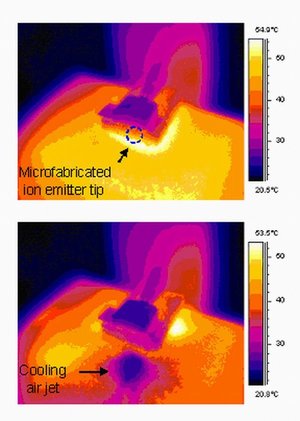
Here are two infrared images showing how the new UW micro-pump cools a heated surface. On the top image, the air pump is off, while it is on in the bottom image. (Credit: University of Washington)
But how this pump works? Here are some details given by UW — but remember that Intel is working on it, so don't expect thorough explanations.

The device utilizes an electrical field to accelerate air to speeds previously possible only with the use of traditional blowers. Trial runs showed that the prototype device significantly cooled an actively heated surface on just 0.6 watts of power.

The prototype cooling chip contains two basic components: an emitter and a collector. The emitter has a tip radius of about 1 micron – so small that up to 300 tips could fit across a human hair. The tip creates air ions, electrically charged particles that are propelled in an electric field to the collector surface. As the ions travel from tip to collector, they create an air jet that blows across the chip, taking heat with it. The volume of the airflow can be controlled by varying the voltage between the emitter and collector.
Some of this research work has been shown at the 9th AIAA/ASME Joint Thermophysics and Heat Transfer Conference, which was held in June 2006 in San Francisco. The paper presented there was named "Coupled-physics modeling of electrostatic fluid accelerators for forced convection cooling," and is available in the Conference Proceedings for $850 ($750 for AIAA members). Oooch!

Anyway, you can keep your habits of opening your laptops and desktops to clean the dust around the fans for several years. According to the researchers, several challenges remain before their device can be used by semiconductor companies.

Sources: University of Washington news release, via EurekAlert!, August 23, 2006; and various web sites.

Commodore brand reappears on high-end PCs

From The Inquirer:
IF YOU remember Commodore 64 that means you are not a teenager any more. We certainly spent a piece of our life playing with that machine in the dawn of PC gaming.

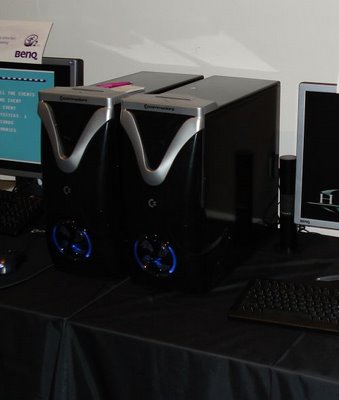
Now, the Commodore brand sits on a range of high-end PCs equipped with Nvidia's 7950 GX2 card and an AMD FX 60. Commodore is now a Dutch company and is testing the waters to see is there a market for such a PC with this legendary brand on it.

The company picked a nice looking case packed some high-end hardware to beef up ye olde Commodore logo.

We we're able to try out the the old games on the beast. µ

ATI leads Nvidia in GPU price/performance across the board

From TomsHardware:
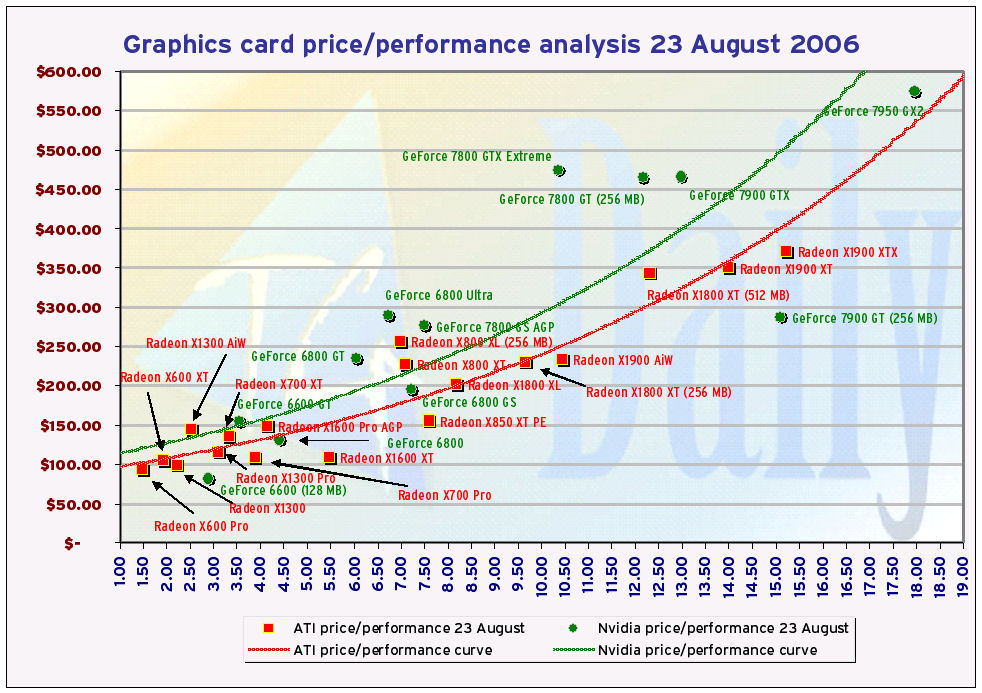
In the first test results compiled using Tom's Hardware Guide tests of relative graphics card performance, and average sale prices sampled yesterday by PriceGrabber, ATI-brand graphics cards led Nvidia across the board, with a few noteworthy exceptions. In our new projected price/performance curve for GPUs, ATI takes the lead in both the value and premium segments.

Using the same premise as our tests for dual-core CPU price performance in past weeks, we projected exponential price/performance best-fit curves for all GPUs whose cards Tom's Hardware Guide has tested over the past two years, for both Nvidia and ATI brands. TG Daily then averaged the prices for multiple models of graphics cards using these same GPUs, from manufacturers including Asus, BFG, XFX, PNY, and MSI.

For the new performance index, we chose a 128 MB Nvidia GeForce 5900 to serve as the "1.0" factor. So for example, a GeForce 7950 GX2 with an index score of 17.97 performs almost 18 times better than the 5900, which launched in mid-2003. Although the 7950 GX2 has the best overall performance score, ATI's Radeon X1900 XTX sells for $370.75, which is 26.5% less than what we project a hypothetical Nvidia card would sell for ($504.58) if Nvidia were to make one whose performance score was also 15.23. The 7950 GX2 sells for $575.14 on average.

Despite that, Nvidia's 256 MB GeForce 7900 GT may be the price/performance leader among all graphics cards currently available, with an index score of 15.10 and an average price of $287.69.

Wednesday, August 23, 2006

Most anti-Google article I've read

So Justin Martin of FSB Magazine doesn't really like Google. He says there is a love hate relationship with small businesses and Google, but it seems all evidence is to the contrary in this article.

Allan Keiter awoke one recent morning to the scary news that his Atlanta company's website was nearly impossible to find on a Google search. His site helps consumers compare cellular calling plans.

Until that morning, the site had often ranked in the top-ten nonpaid results for search terms such as "free cell phones" and "family plans." And like thousands of other businesses, Keiter's company relied on free Google searches to drive customers its way.

"Google is going to bleed away a lot of our sales," software developer Mike Landis, near his office in Asheville, N.C.

Keiter had fallen victim to what's known as the dreaded Google dance: sudden, seismic shifts in search results that occur whenever Google's engineers decide, without warning or explanation, to tweak the software algorithms that determine how the mighty search engine processes keywords.

It's like owning a shop on a busy street corner where all the pedestrians suddenly and mysteriously vanish.

In the months after he fell prey to the Google dance, Keiter saw his revenues plunge some 20%. When he contacted Google for an explanation he was simply told that the algorithm was secret sauce. "There was nothing I could do," he says. "They make changes in their ivory tower, and it ripples through to the little guy."
I think small businesses relying on just one search engine for traffic is a bad idea. Here is some Google love:

Thanks to Google, many startups have reached profitable niche markets at little cost. Take Shark Diver, a San Francisco adventure-travel company that Patric Douglas founded in 2000. Shark Diver (sharkdiver.com) arranges tours to tropical locales worldwide where shark fans can frolic underwater with their favorite predators.

Douglas, 38, estimates that at most, 100,000 people in the U.S. possess the requisites for this pursuit: diving experience and a crazy streak. By bidding on search terms such as "cage diving" in Google auctions, he has been able to zero in on his target market. Shark Diver is now a profitable business with 20 employees and about $1 million in annual revenues, according to Douglas.

His thoughts on Google? "They're gods. Back in the day, there's no way I could have drilled down to a niche this small."

More established businesses have been able to slash their marketing budgets by switching to search-term advertising. Ray Allen, 64, quit the cutthroat New York City advertising industry to start American Meadows (americanmeadows.com), a wildflower-seed company based in Williston, Vt.

Ten years ago Allen was spending $300,000 a year on magazine ads and print catalogs to generate about $1 million in annual revenues. Today he spends just $120,000 a year (mostly with Google, but also with Yahoo's (Charts) competing pay-per-click ad service) to generate more than $2 million in revenues. "This is a total revolution," crows Allen.
So hey, Google does good, huh? Not according to this article when they talk to a small book publisher:
Google's recent move to assemble a vast digital library of books is viewed as a threat by much of the global publishing industry. Google decided to forgo the usual process of obtaining permissions from thousands of book companies.

Google stresses that any publisher can keep its books from being digitized simply by sending a list of titles to Google. But that's not good enough for Lynne Rienner, whose Boulder-based book publishing company is 22 years old, has 20 employees, and books less than $5 million a year in sales.

"Google is trying to turn the copyright laws on their head," she says. "Why should I have to let Google know which books they can't copy? They should be seeking permission from me regarding which books they can copy."

Rather than compiling a list of her company's 1,200 titles ("a waste of my staff's time"), Rienner fired off an angry letter to CEO Schmidt. Google responded with a letter agreeing not to copy any of her books. Rienner is unmollified. She worries that she will be cut out of some future digital moneymaking opportunity. "Books are my unique content," she says. "I'm sure the smart people at Google are busy dreaming up all kinds of ways to make money off them."
What most makes this article irritating is the book publishers. Do they not know that billions of people have access to the internet and can therefore search for the most obscure book that would otherwise never be found. Say I wanted to find a book on Purple headed dinosaurs in Cretaceous and Jurassic periods. And there is only one book on that subject. Lets say the publisher of said book didn't want it cataloged into Google's library, would the user find the book? Nope.

What this small publisher needs to realize is that her sales would most likely increase by a significant amount. But all she is worried about is her books being copied illegally and Google making money off her books.

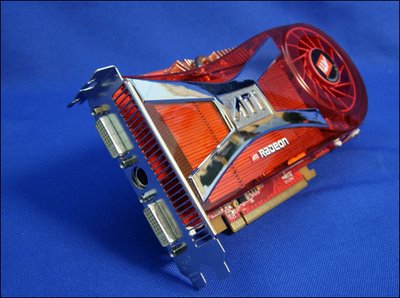
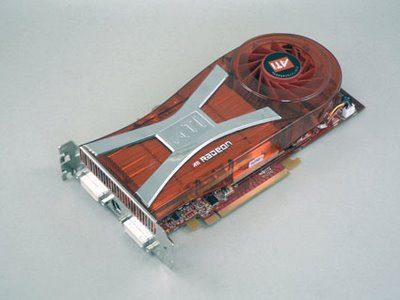
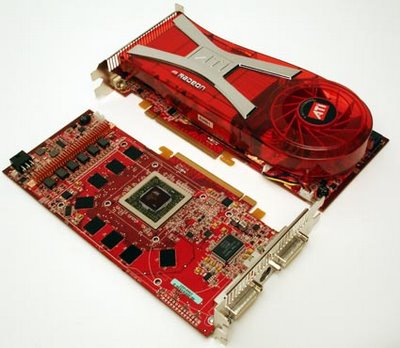
ATI throws down Radeon X1950 series with GDDR4

X1950XTXX1950XTXX1950XTXTomsHardware ran some quick tests:
ATI claims that the X1950 XTX can beat competing dual-GPU solutions by using just one processor. Tom's Hardware had the chance to send an initial X1950 XTX card through our test parcours and found that the ATI card prevailed over Nvidia's cards in six out of ten relevant benchmarks. However, the card achieved this result mainly in low screen resolutions and was able to win only one benchmark in an "extreme HD resolution" of 2560x1600 pixel.

For some users, it may not be the performance of the X1950 XTX that may be especially appealing, as Nvidia's GX2 offers superior performance on large screens. Instead, ATI's cards could be viewed as the better deal at a suggested retail price of about $450 - which is about $100 below the average retail price of Nvidia's Geforce 7950 GX2 cards.

Conclusion

We would have liked to have more time with the cards than we had, but will come back with more reviews. This preliminary look into the single-card operations bodes very well for the red company from up north. At $449 the Radeon X1950XTX is a very nice buy. If you plan an upgrade in the near future, this new addition sweetens the deal.

If you are looking for more for a bit less, the Radeon X1900XT 256 is right up your alley. At a suggested retail price of $279, these look to be a good buy for those who seek a solid gaming card for a less-than-astronomical price.
Extremetech has a full test:
At the end of the day, the worth of the Radeon X1950 XTX comes down to this: Does the improved memory bandwidth you get from GDDR4 really make a difference if you don't change anything else about the card? Unfortunately, the answer is no. In most games, at high resolutions like 1600x1200 with 4x antialiasing and 8x anisotropic filtering applied, the speed goes up by a modest 5% to 8% over the Radeon X1900 XTX. If that's all you get from an almost 30% increase in memory bandwidth, color us unimpressed.

Though the relative speed boost of the new X1950 XTX card is minor, it's still quite an impressive card. It's faster in most games than any other single graphics card, edging out the overclocked XFX GeForce 7900 GTX by a hair. ATI tells us the MSRP will be $449 for both the regular X1950 XTX and the CrossFire Edition card (finally, they're killing the price premium on the CrossFire model). If that's the case, it will cost about the same as most of the non-overclocked GeForce 7900 GTX cards, and about $70 more than the Radeon X1900 XTX.

The performance king of the hill is still the GeForce 7950 GX2, which of course we would expect from a single-slot SLI solution. The GX2 is significantly faster in many games, but it's also significantly more expensive, around $550 to $600. That $100 to $150 difference just about puts it in a totally different price class. If you watch for sales, though, you may be able to find a 7950 GX2 card approaching the $500 price point.

If we were looking for a really fast high-end graphics card, would we pay the extra money for the X1950 XTX? Probably not. The new cooling solution on the X1950 XTX is definitely a bit less annoying, but the recent price drops of the X1900 XTX combined with the relatively small performance increase in the X1950 XTX make the X1900 XTX a better deal. If the X1950 XTX falls in price a little bit, it will be the preferred model.

Unfortunately, we didn't have time to do a thorough, high-resolution test of both ATI and Nvidia's high-end dual graphics configurations. It could be that at extremely high resolutions, ATI's improved memory bandwidth makes a big difference. The company even claims they can beat Nvidia's Quad SLI—a claim we find hard to believe. We'll test that and let you know how it shakes out in the near future.

So when would you be able to buy one? ATI originally planned to launch today (August 23rd) with availability guaranteed by September 4, though retailers could sell cards as soon as they got them. It turns out that there were some supply hiccups with the GDDR4 memory, and the release situation has changed a bit. Today is still the official "launch," but retailers have been told to hold product and make it available everywhere on September 14. ATI tells us to expect a "flood of availability" on that date, and that's a promise they'll have to make good on.

Conclusion

At $450, the initial launch price of the Radeon X1950 XTX is pretty aggressive. If the usual rate of video card price decay holds true, it will be a really nice card to pick up when it drops below $400. In fact, it would be a great deal now if price decay on the X1900 XTX cards hadn't pushed those down to the $379 mark, making them a better bargain (18% cheaper for a 5% to 8% drop in performance). Though this is a very good graphics card, in the current competitive landscape, there are two better options: The "money is no object" customer is best served by the wicked-fast GeForce 7950 GX2, and the "wants the best value for a high-end card" customer should pick up a Radeon X1900 XTX.

Tuesday, August 22, 2006

3-D Pac-Man Prank

Dvorak: Google's Free Municipal Wi-Fi May Start Revolution

From Foxnews:

Google has been toying with the idea of implementing free municipal Wi-Fi.

I've always believed that it began as a whim, but became a subtle threat aimed at the major carriers who are saber-rattling over tiered service, threatening to charge Google (GOOG) more for its supposed free ride on their networks.

This, of course, is ludicrous, since there is no free ride for anyone.

Anyway, somewhere along the line, the concept of Net neutrality emerged. This new concept got Congressional attention soon after Google suggested that it could use a Wi-Fi mesh to light up the city of Mountain View, Calif., and then San Francisco for free.

Now to prove that it can do this, Google actually has lit up Mountain View. Anyone driving through the town can pull off the road and do e-mail for free.

It cost Google a million dollars to pull this stunt off, but that's chicken feed for Google — a fact we cannot overlook.

But here is the killer. What if suddenly — from this experiment — Google discovers that localized service combined with localized search and local advertising (specific to the target community, aka Mountain View) can not only pay for the system but provide a new profit center? What happens if that turns out to be an unintended consequence?

If the numbers work out, we're talking about a new gold rush. And Google wouldn't be the only player. Microsoft (MSFT) would have to do this, and so would Ask and Yahoo! (YHOO).

After that — and this is very possible with 802.11n — there is no reason Google couldn't offer an IPTV package and cut out the cable companies, too.

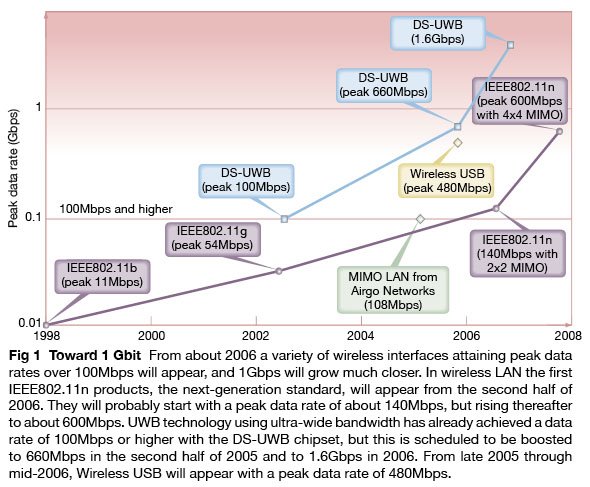
You need only 30 Mbps to do it, and that includes HDTV service. 802.11n, when fully finalized, will deliver 300 to 600 Mbps.

This expansion of services is entirely possible and doable. And it all stems from the phone companies and cable companies arrogantly shooting off their collective mouths about tiered services, along with their cavalier failure to give the American public what it needs — universal and cheap high-speed access.

Now they have to contend with being beaten at their own game. Good luck.
I completely agree with Dvorak on this one. What Google needs to do is give everyone free access to their services, then charge for premium content once users are there. Cable and Telcos will be up a creek without a paddle. This quote sums up exactly how and why this will work:

Many may have forgotten that in the late 90's hundreds of miles of fibre was laid only to end up as "dark fibre" (un used fibre due to the lack of finance/backing to connect to the end user).

Google for the last two years has been slowly buying up the rights to allot of this dark fibre leading to allot of speculation as to why.

Then Google starts building super nodes that fit into a large shipping container.

Now we have Google offering free Wifi on a small experimental basis.

Next year Wimax routers and chip sets hit the consumer market offering 75Mb/s both way speeds and up to 8Km of range from the base station.

If you not seeing the game plan now your blind.

Google is going to do the biggest smack-down within the next three years ever seen and the Telco's will be sitting there going "er what just happened".

The free wifi is actually part of the game plan, google is just waiting for a better technology to finalise the game and with the advent of Wimax next year its going to be check mate and game.

Highway regulators: Car 'black boxes' can't be secret

Proponents of black boxes in autos say the devices promote safe driving. This General Motors sensing and diagnostic module--part of a car's airbag system--is one type of black box.
Road Safety International's $280 RS-1000 black box is designed to help teen drivers stay out of trouble. The box connects to a car's onboard electronic system and measures the car's speed, as well as its cornering and braking forces. The device emits a noise tone if the driver goes out of bounds.
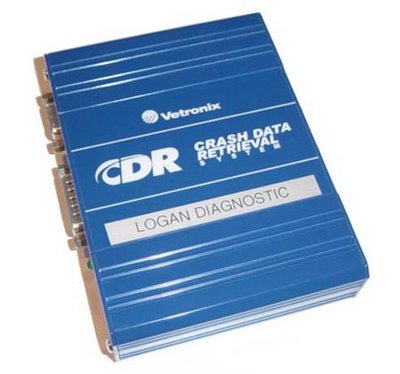
Vetronix makes a $2,500 tool that can download data from General Motors' and Ford Motors' black-box-equipped cars. Critics of the devices say people's privacy rights could be violated in the absence of regulations governing how the data can be used.
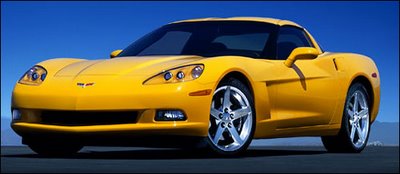
Manufacturers are increasingly turning to high technology to differentiate their products in the hypercompetitive auto market. General Motors' Corvette is among the models that come equipped with a black box.

From Cnet:
The government will not require recorders in autos but said on Monday that carmakers must tell consumers when technology that tracks speed, braking and other measurements is in the new vehicles they buy.

Kevin Mitnick Web site hacked

From ZDnet:
Instead of the usual description of Kevin Mitnick, his consulting services and books, the famed hacker's Web site on Sunday displayed a vulgar message.

Online vandals, apparently operating from Pakistan, broke into the computer hosting Mitnick's Web site on Sunday and replaced his front page with one of their own. As a result, four Web addresses belonging to Mitnick, including KevinMitnick.com and MitnickSecurity.com, displayed an explicit message on Mitnick and hacking.

Mitnick's name is synonymous with "notorious hacker" for many. He was caught by the FBI in 1995 after a well-publicized pursuit and spent five years behind bars for wire and computer fraud. Today he is a consultant, has written two books, and spends much of his time on the road at speaking engagements.

Monday, August 21, 2006

Intel Core 2 Duo E6400 invades AMD territory on price/performance chart

From TomsHardware:
The latest round of seasonal CPU charts updates from Tom's Hardware Guide reveals what we expected, now that we've had a chance to test Intel's Core 2 Duo E6400 dual-core CPU: At $247 average selling price, according to today's figures from PriceGrabber, it could be the most powerful CPU you can buy today for the fewest dollars...at least until figures from the E6300 are tallied.

The Summer CPU charts enabled us to make seasonal adjustments to our performance indices, along with replacing performance estimates with across-the-board real-world figures for Unreal Tournament IV and older processors. The new figures give the E6400 a performance index score of 2.74, meaning that in the five categories of tests we've accounted for - applications, gaming, synthetic processing, audio encoding, and video encoding - the THG test system with the E6400 CPU delivered an average of 274% the performance of an old single-core Pentium 4 2 GHz CPU, which currently sells for about $77 on average.

The E6400 is the lowest-priced CPU that THG has tested whose price falls below our projected AMD price/performance curve. Given the assessed performance of all known AMD dual-core desktop processors, a hypothetical AMD processor whose performance index score was also 2.74, would sell for $537.17. And as our new-format chart shows, the nearest real-world competitor to the E6400 is AMD's Athlon 64 X2 5000+, whose index score is 2.72 but which sells for $360.

SanDisk unveils 8GB music player

From Cnet:
On Monday, flash storage specialist SanDisk cut prices across its e200 line of digital-music players and introduced a new high-end model, the e280.

Priced at $249.99, the e280 has storage capacity of 8GB, or roughly 2,000 songs. At the low end of the line, the 2GB e250 now costs $139.99. The e200 models have a 1.8-inch screen and feature a digital FM tuner and voice recorder.

SanDisk, which holds the second-largest market share in digital-music players behind Apple, introduce a $249.99 MP3 player, the Sansa e280, with 8GB of storage capacity.

That is enough to hold about 2,000 songs, which is double the capacity of the similarly priced iPod Nano, Apple's best-selling digital-music player, the report said.

SanDisk also is cutting prices on its other music players, including existing 2GB, 4GB and 8Gb models, by almost 30 percent. The low-end 2GB Sansa e250 now costs $139.99.
I wonder if this is able to compete with the Ipod Nano. Since this is 8GB and is the same price as the 4GB nano, this should be awesome, right? Not according to this reviewer who has played with the SanDisk unit:
I would've bought a SanDisk, but they don't support AAC, and the scroll wheel is just too small, and it sticks out too far, making the buttons difficult to press. Yeah, I bought a nano 4 gigger.

Farecast launches for 55 US cities

From Techcrunch:
Seattle startup Farecast is taking their airfare prediction technology nation wide today, flights departing from 55 US cities are now available for price history, predictions and buy/wait recommendations. The site also offers RSS feeds for automatically tracking fares and predictions over time.

Farecast received $8.5 million in funding from Greylock Partners, Madrona Venture Group and WRF Capital. Development and testing of the site has taken 3 years. The site was named by Time Magazine as one of the 50 coolest sites on the web this year. It’s a real crowd pleaser and I’m sure many people will be interested in trying their services out now that they’ve extended their reach.

Updated price/performance chart reflects single-day AMD price drop

From TomsHardware:
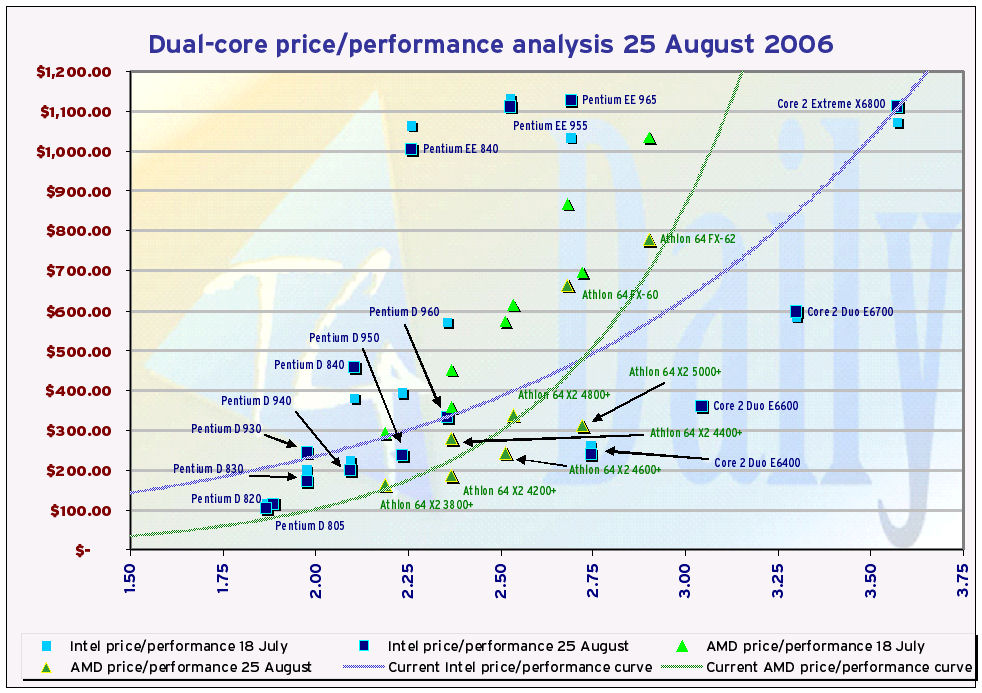
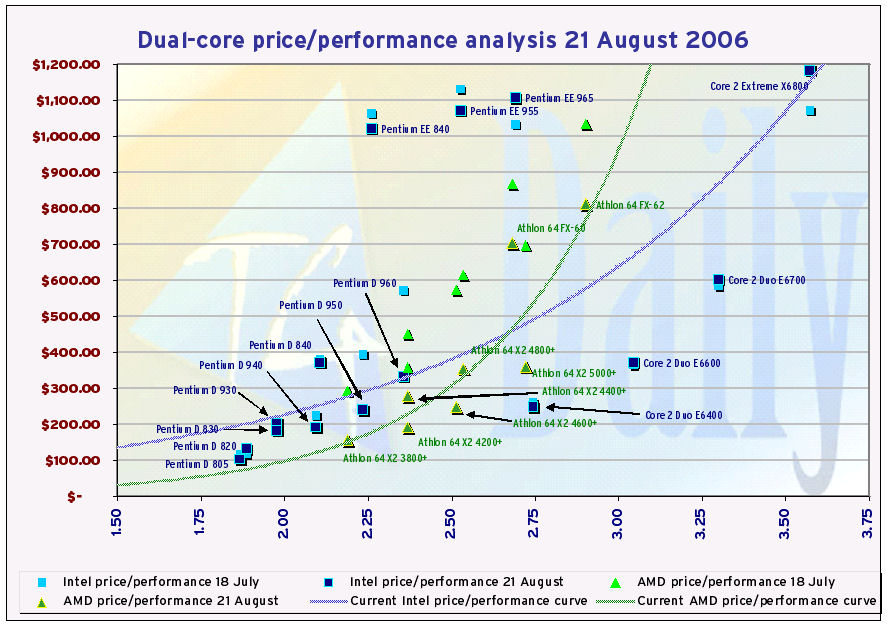
Besides an obvious size advantage to the new chart, here's what we're doing differently now: Gone are the fishing-line-looking marks connecting the different product lines, which some of you said were making the chart more difficult to read, especially with the addition of the Pentium EE series to the mix. In their place are labels which point to the current price/performance plot points for each dual-core processor we've tested.

All you need to remember are two colors: Intel is blue, AMD is green. All the current plot points are dark; all the plot points for the past (in this case, one month ago) are light. Intel's points are squares; AMD's are triangles. Only the current-day plot points are labeled, but to find the one-month-old plot point for the same processor, look for the lighter-colored point that rests along the same vertical line as the dark point. For example, the dark blue box in the upper right corner represents Intel's Core 2 Extreme X6800, with an index score of 3.51 and an average price for today of $1,195. Directly below it on the same vertical line is a brighter blue box that represents the Core 2 Extreme's price one month ago ($1,072), when pre-orders were being taken.

The only two lines remaining on the new chart are the trendlines - the curves themselves, which are exponential best-fit curves whose points most closely approximate the actual prices. As the prices change from day to day, so do the performance curves. You can clearly see which processors fall way off these curves - AMD's FX series, and Intel's Extreme Edition dual-cores with hyperthreading. We've heard from some of you that either or both series should be removed from our estimates, and we're taking your advice under consideration. But we also heard earlier from others who have said, as long as we're testing the FX series, we should also be including the EE series.

The two curves clearly carve out Intel's and AMD's respective leadership territories on this map. Currently, they intersect at about $480 and about 2.65 on the index. To the lower left of that point is AMD territory, where anything below that price will generally yield better performance per dollar from AMD than Intel. But in recent days, Intel's Pentium D 820 has been challenging the AMD curve at about $115 - a theoretical AMD equivalent would sell for $90.71. Meanwhile, prices for Intel's popular Pentium D 805 have plunged to $93, according to PriceGrabber, although Tom's Hardware Guide has yet to test the 805 for performance.

What are the best performance values on the market today? There are two divisions right now: AMD has the low-price market, while Intel has secured the high ground and is aiming for the middle ground. While the lowest-end AMD dual-core processors have the highest price/performance value on the low end, both Intel Core 2 Duo processors show exceptional value. The reason: Perhaps AMD's best price-performer today is the Athlon 64 X2 5000+. At $360 and an index score of 2.57, it sits more than 21% below the Intel curve. But for just $24 more, you can buy a Core 2 Duo E6600 with an index score of 2.91 which is like getting an extra 34% of a Pentium 4 2 GHz at just 30% the extra price.

Tom's Hardware Guide provides us with the performance data we use for our estimates. Intel has yet to make Core 2 Duo E6400 and E6300 units available for testing. When they do, we admit you could see the Intel price/performance curve taper down a little bit, with E6300 prices currently at $218 - very price-competitive even with the Pentium D 950 at $236.

Sunday, August 20, 2006

Shuttle develops XPC-based car information system

From Digitimes:
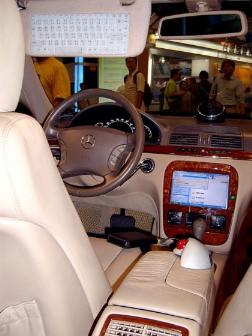
Taiwan-based small-form-factor (SFF) PC specialist Shuttle appeared at the first standalone CarTronics show this weekend at the Taipei World Trade Center (TWTC), introducing its new R&D project, which targets the car-electronics market. This year, the company plans to invest about US$2 million in developments of car-use information systems based on its well-known XPC concept, according to Ken Huang, Shuttle vice president of systems development.

Shuttle's contribution to this year's CarTronics is represented by a luxurious Mercedes S-Class sedan equipped with a prototype of the XPC-based car-use information system. Placed between two rear seats, Shuttle's XPC SN21G5 mini PC performs as a key part of the system that functions as a platform for applications, such as GPS-based navigation, voice control and entertainment services. It also enables communications via Skype, MSN and other software, using 3G wireless modem technology, and in the future, Shuttle's car PCs will support WiMax, Huang said.

The prototype at CarTronics includes AMD's Athlon 64 3700+ CPU, 1GB of DDR DRAM and a non-standard power supply unit to support 12V DC power supply in vehicles. It runs on the Windows XP Professional operating system (OS), with the SP2 service pack and voice recognition engine installed, but later on, Shuttle's car-use PCs will utilize the upcoming Windows Vista OS, according to Huang. In addition to the mini PC, the system includes three LCD monitors (two in front of back-seat passengers and one as a part of driver's dashboard) and four webcams. Its audio subsystem consists of two subwoofers, thirteen speakers and four microphones. Input devices are represented by two keyboards, which are mounted into driver and front-passenger visors, and one trackball. Optional units can be added using USB ports of the mini PC, while a printer, as displayed at the show, can be placed in the rear cargo area.

Shuttle's partner to showcase the car-PC concept at CarTronics is Taiwan-based Alsolox, which is focused on car-security solutions. According to Huang, the two companies recently started working together on the project. He added that Shuttle will likely begin more actively promoting its car-PC solutions by the fourth quarter of this year, targeting car dealers in Taiwan at the initial stage. Then, the company will approach car vendors and expand the business to overseas markets. According to Huang, Shuttle currently expects that car-PC solutions may start generating sales next year.

Friday, August 18, 2006

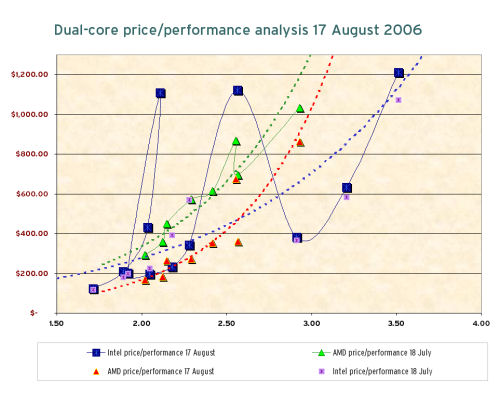
Some AMD Athlon 64 X2s now 41% below Intel price/performance curve

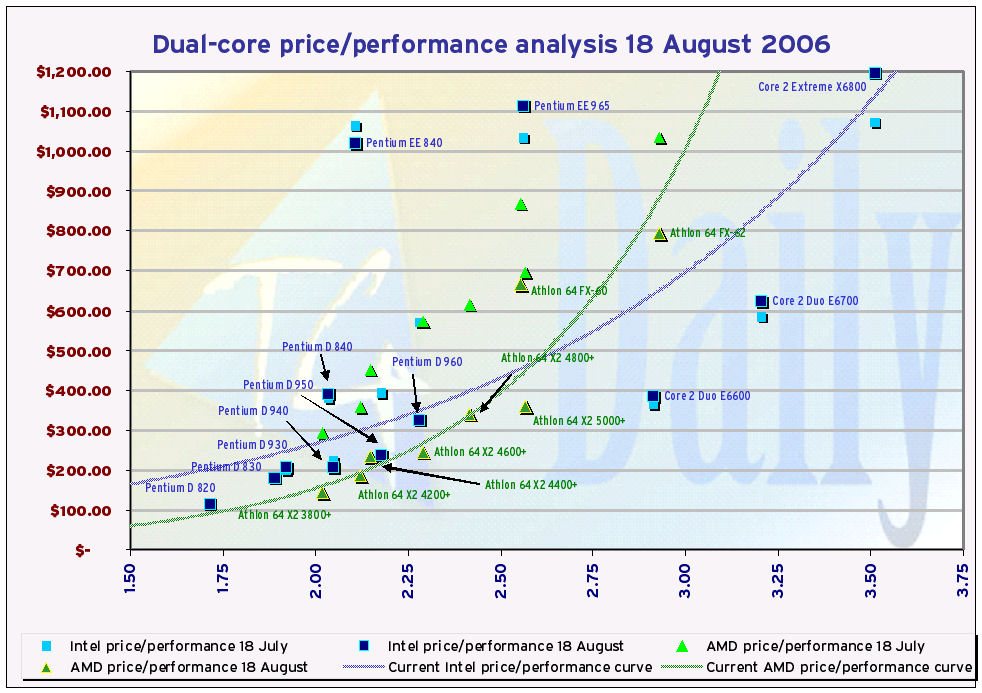
Almost one month after AMD signaled it would respond to Intel's then-forthcoming Core 2 Duo and Core 2 Extreme releases with substantial price cuts, based on the latest performance data from Tom's Hardware Guide, TG Daily now projects that average street prices for Athlon 64 X2 processors now fall as much as 41.4% below the price/performance curve set by comparable Intel processors.

Our price/performance curves for Intel and AMD dual-core processors are based on the latest benchmark data obtained from Tom's Hardware Guide. We've projected a performance index for these processors based on how well they perform in five distinct categories, relative to how well an old single-core Pentium 4 2 GHz CPU used to perform. This morning, we updated our data with the latest performance results in general number crunching, gaming, applications, video processing, and audio processing, with each category representing 20% of the total score. We've also added new data for two dual-core Pentium Extreme Edition series processors, the EE 840 and the EE 965.
The new chart shows the latest results, now that the EEs have been added to the mix. In terms of performance, the EEs are the most expensive processors still on the market; in response to reader requests, we're including them in our tracking. Their addition doesn't change the fact that the Core 2 Duo and Core 2 Extreme are now the best overall performers that THG has tested thus far; in fact, the EEs actually help establish Intel's newer models as better values. At $1,107.86, the Pentium EE 840, with a performance index score of 2.11, fails to demonstrate its performance value when pitted against a Pentium D 840, with an index score of 2.04 and an average price of $432. (A 2.04 score means the D 840 is 204% the performer that the P4 2 GHz was.) However, it's worth noting that the EEs are less popular as a result, just today falling off the chart of top 100 processors currently tracked by PriceGrabber.

As economic analysts will tell you (and as a few of whom told us), a price/performance curve is generally exponential. On the latest chart, the green dotted line projects AMD's curve last 18 July - in other words, you could use this curve to estimate how much an AMD processor would have sold for last month, given only data about how well it performs. The blue dotted line represents Intel's current curve, which is admittedly dragged up a bit by the addition of the EEs. Core 2 Duo and Core 2 Extreme prices have risen marginally in the last few weeks, though they've tapered off in the past few days. After selling for as high as $1,298 on Tuesday, according to PriceGrabber, Core 2 Extreme prices have fallen to $1,211. On the lower end of the spectrum, Core 2 Duo E6300 prices are now selling for an all-time low of $217.

But AMD's prices, surprisingly, have continued to fall steadily, especially in recent days with news of the upcoming Athlon 64 X2 3600+ for the low end. The projected price for that processor is said to be $149, but already the 3800+ is selling for as low as $167. A hypothetical Intel dual-core processor with a comparable index score of 2.02, based on our revised numbers, would sell for $283.44; and the closest real-world match to the 3800+ is the Pentium D 840 scoring 2.04, and selling for $432. The 4200+ is currently the best value among AMD processors. With an index score of 2.12 and an average price of $183, the 4200+ sells for 41.4% less than a hypothetically comparable Intel processor. In the real world, it sells for a staggering 83.5% less than Intel's Pentium EE 840, whose index score is 2.11.

With AMD prices continuing to fall, the stage appears to be nearly set for the other shoe to drop: a possible new FX series processor that enables the FX-62's prices to fall, or a possible "4x4" series processor that takes over the premium side of AMD's price/performance scale. If neither of those possibilities come to fruition, Intel's Core 2 Duo E6700 could carve a sweet spot for itself on the premium side. With an index score of 3.21, the E6700 currently sells for an average of $634, according to PriceGrabber. A hypothetical, comparable AMD processor would sell for $1,502.10.

Boeing 747 Large Cargo Freighter Rolls Out; Prepares for First Flight

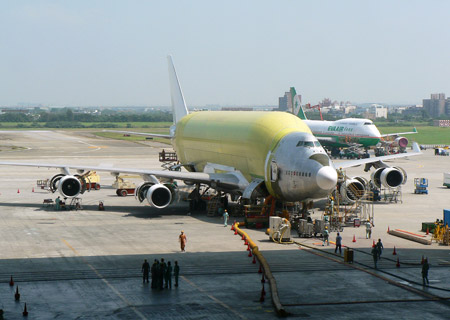
Boeing has rolled the first 747-400 Large Cargo Freighter (LCF) out of the hangar at Taipei's Chiang Kai-Shek International Airport. The enormous airplane is the first of three specially modified jets that will be used to transport major assemblies for the all-new Boeing 787 Dreamliner.

"This is one of the most unusual modifications Boeing has ever done," said Scott Strode, 787 vice president of Airplane Development and Production. "We've relied on the world's best talent to design and build the LCF and we can all be proud today to see it standing on the tarmac."

Ground testing is under way to prepare the LCF for its first flight. After initial flight testing in Taipei, the LCF will fly to Seattle to complete the flight test program. First flight and the ferry flight to Seattle are expected to occur by the end of August.

The modifications have been performed by Evergreen Aviation Technologies Corp. (EGAT), a joint venture of EVA Air and General Electric and a part of Taiwan's Evergreen Group. The second airplane continues to be modified and will be completed this fall. The third airplane will begin modification next year. The first two LCFs enter service in 2007 to support the final assembly of the first Dreamliners.

Thursday, August 17, 2006

International MXT-MVA Extreme Armored Vehicle


From Gizmag:
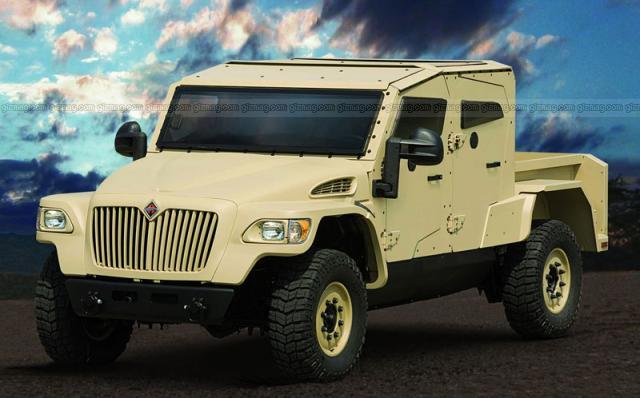
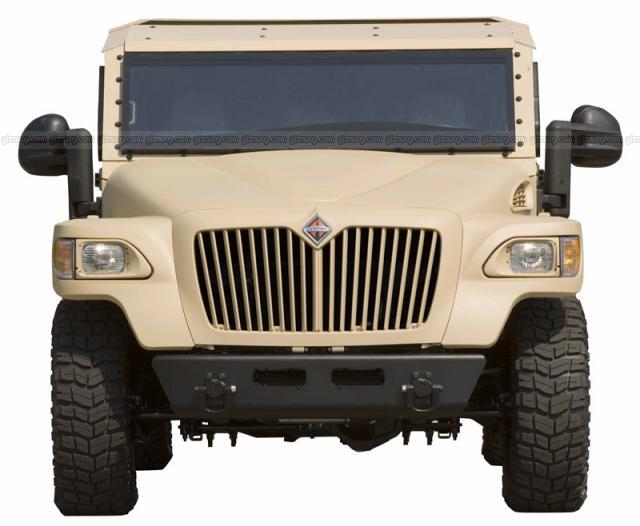
The world’s most macho vehicle range has added an armoured variant in the form of the International MXT-MVA (Military Vehicle - Armored) shown for the first time yesterday at the U.S. Army’s Aberdeen Proving Grounds. The MXT-MVA is an all-terrain, armored wheeled vehicle platform designed to provide a new level of ballistics and blast protection on the battlefield and against the new threat of Improvised Explosive Devices (IEDs).

It is a derivative of the MXT 4x4 Pickup which makes an ideal base as it is so big that the crew cab can seat five sumo wrestlers with ease (providing one of them can drive) and the tray can carry a jet ski or a motorcycle with the tailgate up. Not surprisingly, the MXT-MVA can handle the weight of the armor with ease, especially over long distances, rugged terrain and when maneuverability is critical. Powered by a 300-horsepower International V8 diesel engine with 530 lb.-ft. of torque, additional armor does not adversely affect the vehicle's superior payload ability, towing capacity or durability. The cab can be configured to fit as many as six crew members in full gear, while the body of the MXT-MVA is versatile enough to accommodate an array of weapons, navigation and communications systems and applications such as convoy protection, field shelter, ambulance and communications units, which are seamlessly integrated with the company's proprietary multiplexed electrical system.

International Military and Government LLC (IMG) is a wholly owned subsidiary of International Truck and Engine Corporation, and has collaborated extensively with established armor providers and military development engineers within the US Army Tank-Automotive Research, Development and Engineering Centers (TARDEC) National Automotive Center to develop the right armor solutions for the full spectrum of military operations.

Free F.E.A.R. Combat

Sierra Entertainment today announced that the multiplayer component from the award winning PC title F.E.A.R.™ has been renamed F.E.A.R. Combat, and will be made available to the public as a free download on Thursday August 17th, 2006. F.E.A.R. Combat is the complete multiplayer component of F.E.A.R. and includes all the updates, additional official maps and additional official game modes all in one downloadable file. F.E.A.R. Combat users will be able to play against the owners of the retail version of F.E.A.R. as well as the other F.E.A.R. Combat users.

3Com's 3108 WiFi VoIP phone gets FCC nod


From Engadget:
Looks like 3Com is dipping its toes in the ever-growing VoIP phone pool, with its 3108 wireless phone recently snagging that much-needed FCC approval. This one is SIP-based which means it'll work with just about anything as long as it's not Skype, unless it has some dual-mode action 3Com's not telling us (or the FCC) about -- so we're guessing not. Still, if it suits your needs, the phone looks to be decent enough, with a 1.8-inch color LCD, 2.4GHz external antenna, firmware that can be updated over WiFi, and a range of about 65-165 feet indoors and a purported 820 foot range outdoors in line-of-sight. The fact that it also looks like a regular phone doesn't hurt either, given the sorry state of some VoIP phone designs. With all the info we've got coming from the FCC filings though, that of course means we don't know how much it'll cost or when it'll be available.

Intel roadmap confirms 2.67 GHz quad-core Core 2 Extreme

From Toms Hardware:
A new version of a roadmap distributed by Intel to its closest partners lists the upcoming quad-core "Kentsfield" as the new flagship of the firm's desktop processor portfolio. The new Core 2 Extreme will arrive with a clock speed of 2.67 GHz, more L2 cache and substantially higher power consumption.

If it is only the fastest processor that matters to you, then your 1P dual-core processor system will be outdated by the end of this year. AMD will soon be introducing a 2P platform, called 4x4, with two dual-core processors that transition the company's high-end offering to the first native quad-core processor scheduled to launch in Q2 or Q3 of next year; Intel's Kentsfield, which is promised to be available in time for the holiday season, will not be a "native" quad-core since it will combine to dual-core Conroe cores in one package, but it will be the first quad-core processor available on the market.

The roadmaps currently distributed confirm an earlier report on TG Daily, which stated that the quad-cores Kentsfield (desktop) and Clovertown (1P and 2P server and workstation, due in Q1 2007) will run at 2.67 GHz, slightly down from today's 2.93 GHz and 3.0 GHz for the dual-core versions. According to sources, the processors will grow significantly in size and double the L2 cache from 4 to 8 MB per processor. Positioned on the very high end of each segment, Intel pushes once again the power envelope to an expected 110 watt (up from 75 watts of the 2.93 GHz dual-core Core 2 Extreme and 80 watts of the 3.0 GHz dual-core Xeon 5160), which is still below the 125 watt of the Athlon 64 FX family and should provide some room for overclockers. Sources told TG Daily that the Core architecture will be good for at least 4 GHz in commercial systems down the road.

Kentsfield will continue to be running on FSB1066 and use the 975X chipset.

It is unclear at this time what will happen to the current Core 2 Extreme, which was confirmed by Intel to be available as a 3.2 GHz version by the end of this year. The roadmap does not list such a chip and in fact shows the dual-core Core 2 Extreme to be phasing out by Q1/Q2 of next year. What we do know, however, is that the upcoming Core 2 Extreme will be the only option at Intel if you want to get your hands on a quad-core processor. Senior vice president David Perlmutter said in a recent interview with TG Daily that we "will start seeing four cores on the high-end and they will be going into the mainstream, but it will take a while. I think that it will be two or three years until you are going to see four cores entering the mainstream."

Boeing to Discontinue Connexion by Boeing Service

From Boeing:

CHICAGO, Aug. 17, 2006 -- The Boeing Company [NYSE: BA] today announced that a detailed business and market analysis of Connexion by Boeing is complete, and the company has decided to exit the high-speed broadband communications connectivity markets. Boeing will work with its customers to facilitate an orderly phase out of the Connexion by Boeing service.

"Over the last six years, we have invested substantial time, resources and technology in Connexion by Boeing," said Boeing Chairman, President and CEO Jim McNerney. "Regrettably, the market for this service has not materialized as had been expected. We believe this decision best balances the long-term interests of all parties with a stake in Connexion by Boeing."

As initially disclosed in the company's second-quarter 2006 financial results on July 26, Boeing now expects to recognize a pre-tax charge of up to $320 million, or $0.26 per share, in the second half of 2006, of which approximately $290 million will be taken in the third quarter and the balance in the fourth quarter. The company also expects a benefit to earnings of approximately $0.15 per share starting in 2007 without further investment in Connexion. The company will update its financial guidance when it releases third quarter results on October 25.

The charge relates to writing down certain assets, payments of early termination fees and other costs related to shutting down the service. Boeing expects the majority of Connexion employees will find other jobs within the company.

Boeing acknowledged it was reviewing the Connexion business on June 26. This effort included an assessment of the market and discussions with existing customers and potential new business partners.

THE WAR AGAINST THE CAPS LOCK KEY IS ON


From Engadget Originally from Slashdot

We've seen our fair share of battles in the consumer electronics industry, but this war is distinctly different than those waged in courtrooms or even conference centers, as the focal point here isn't a person, company, or even an entity. Pieter Hintjens is rounding up his troops in order to bring about a change that's most improbable: to have the Caps Lock key retired, permanently. Although some of you may chuckle at the idea and deem it unworthy of such an effort, we can imagine Pieter isn't alone in his disdain for the awkward key. Judging solely by the rate at which fellow petitioners are claiming their allegiance on the CAPSoff website, there are indeed an army of haters gaining strength. The group's mission is to awaken the public and get them to seriously think about the precious keyboard real estate that is so unfairly utilized by the (nearly) worthless uppercasing shortcut. Hintjens is a man on a mission, but he's keeping a cool head, and by offering up alternatives that could hopefully appease both camps, some sort of resolution can presumably be found; he has suggested that Caps Lock be relocated beside Scroll Lock, so that Fortran programmers (about the only folks on the planet aside from Nigerian email scammers who use this key with any frequency) can still have access to quick uppercasing. Now that you've been briefed, and you're fully aware of what's at stake, there's really only one question that remains: will you just sit around and gawk, or will you fight for CAPSoff?
Hey, we need to just get rid of the keyboard and mouse all-together and control the computer with our mind.

Joel Johnson, Kyosho Evolva, Sirio power win Great Lakes Challenge

From RCcaraction:

Kyosho America's Vice President Joel Johnson and the new Kyosho Evolva 2005 WC Edition win the Great Lakes Challenge! Hosted by the One Eight Racers of Toledo, the Great Lakes Challenge is one of the longest running, most well attended races of the year. Scott Kimbrough took TQ honors with the Kyosho Evolva 2005 WC, and Kyosho placed the most cars in the A final with a total of seven. Joel Johnson was on the wrong end of a first turn incident at the start of the A-final, which left him in last place at the end of the first lap. The superior pace of his Sirio-powered Evolva, however, allowed Johnson to take the lead half way through the race, which he held until the end of the race to earn the title of 2006 Great Lakes Challenge Champion. Andy Powers also took the win in the 1/10 200mm Open class with a new Kyosho V-One RRR Evo, making it a very successful weekend for both of the current World Champion vehicles from Kyosho.

Dell, AMD expected to expand chip pact

From Cnet:

Dell, the last of the big four server makers to accept Advanced Micro Devices' chips into its product portfolio, is expected to announce Thursday that it's expanding its partnership with the chipmaker to include with new AMD-based servers, desktops and laptops.

Wednesday, August 16, 2006

EA-18G Growler flies for first time

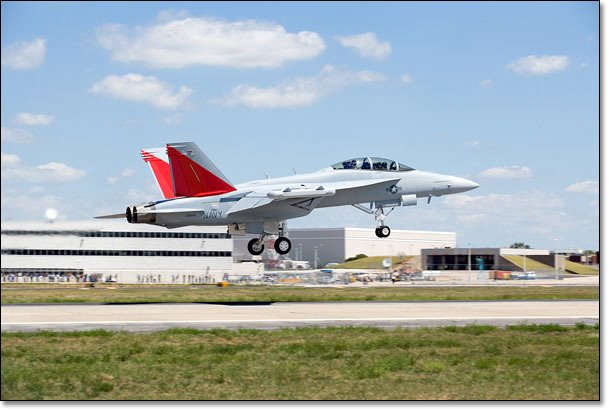
The first EA-18G Growler, EA-1, takes off from Lambert-St. Louis International Airport.
The U.S. Navy's newest aircraft, the EA-18G Growler, took to the air for the first time Tuesday from Lambert-St. Louis International Airport, beginning a new era for Airborne Electronic Attack.

Boeing F/A-18 Chief Test Pilot Ricardo Traven and Chief Weapons System Operator Rick Junkin conducted the flight. The first EA-18G, known as aircraft EA-1, is the first of two test aircraft built under a System Development and Demonstration contract Boeing signed with the Navy on Dec. 29, 2003.

Several members of the Growler team were on hand as the aircraft lifted off, including Boeing EA-18G Program Manager Mike Gibbons, who said of the flight, "This is what we've worked so hard for three years to accomplish. And to do this [one month] ahead of schedule and within budget is a tribute to the entire team."

Junkin said of his role as the electronic countermeasures officer, "The AEA systems are very intuitive to operate and provide the situational awareness to execute the mission more effectively than anything the AEA community has seen before."

Traven echoed Junkin's words, calling the flight "a new chapter in the F/A-18 history book. In the EA world, I feel that the integration of the systems is such a leap in modernization that it's not a new chapter in the EA history book, but the first page in a new book."

A derivative of the two-seat F/A-18F Super Hornet, the EA-18G's highly flexible design enables warfighters to perform an array of AEA missions, operating from either the deck of an aircraft carrier or land-based airfields. The EA-18G will replace the Navy's current aircraft-carrier-based AEA platform, the EA-6B Prowler, that has been in service since 1971. The first production Growler will join the Navy's aircraft fleet in 2008.

Tuesday, August 15, 2006

Cool real time Bandwidth speed check

Don't go to Russell and Smith Honda in Houston

This blogger dropped off his Honda S2000 at the dealership for service work, and before the work is even begun, he gets a call that technician has wrecked his car on an unauthorized test drive.

Searching for bargains on Google Maps

From ZDnet:
Google Maps will begin offering printable coupons for everything from pizza to car washes on Wednesday as the search giant makes a move designed to appeal to peoples' appetites for a bargain.

RIAA drops suit against grieving family

From ArsTechnica:
The RIAA is famous for suing anyone, anywhere, no matter how unlikely the target or how bad it makes them look. Apparently, even its avarice has limits, as the group has decided to drop the suit against Larry Scantlebury's estate. Scantlebury was named as a defendant in one of the RIAA's lawsuits. He recently passed away, and the RIAA graciously decided to stay the case for 60 days while his family grieved his loss.

In response to the uproar surrounding the situation, the RIAA has decided to drop all proceedings against the estate. In a statement, RIAA spokesperson Jonathan Lamy said that "out of an abundance of sensitivity, we have elected to drop this particular case."

AMD intros new Opterons

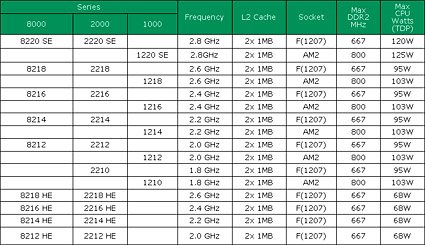
Overview of all 23 new Socket F and AM2 Opteron processors

From Toms Hardware:

AMD today unveiled its first answer to Intel's Core micro architecture. An updated version of the processor that is driving the firm's revenue growth and market share gains claims to not only close the gap to "Woodcrest" but even surpass it in speed and power consumption. And then there is the promise that quad-cores won't consume more power than today's dual-cores.

AMD's new Opteron processors are based on the new Socket AM2 - which has been introduced earlier for Sempron and Athlon desktop CPUs - and Socket F. In total, there are 23 new dual-core CPUs - which do not represent a radical departure from the previous product generation, but a rather evolutionary step for AMD to upgrade the processor that has been challenging Intel in the server and workstation market so successfully in recent months.

On the surface, there are still three Opteron series processors - the "8" series for up to 8P systems, the "2" series for up to 2P systems and the "1" series for 1-way servers and workstations. But the new chips carry a four-digit model number instead of the three-digit number of their predecessors. According to AMD, the number explains the scalability, the socket generation as well as the relative performance within the series. For example, model 2216 (2.4 GHz) is two-way capable (first "2"), carry the second generation socket (second "2") and run faster than the 2214, but slower than the 2218.

All new regular 8P and 2P processors based on the Socket F are rated at a thermal design power of 95W; 1P (Socket AM2) versions run at 103W. Socket F models ranging from 2.0 GHz (XX12) to 2.6 GHz (XX16) are also available in a low-power "HE" version that is rated at a TDP of only 68W and closely matches Intel's Woodcrest processor rating (65W to 80W). Next to the mainstream (95W-103W) and low-power (68W) processors, AMD is also offering a 2.8 GHz high-end model: The 1220 SE and 8220 SE - think "sport edition" - will ask for 125W and 120W, respectively.

Compared to Intel's sparkling new micro architecture, AMD's new Sockets almost look a bit bland. Yes, there is support for DDR2 memory - 667 MHz for F and 800 MHz for AM2 - and there is AMD's virtualization feature, previously code-named "Pacifica" and now officially introduced as "AMD-V." The question, however, is if that will be enough to maintain the firm's current momentum against Intel's much praised Core architecture.

In a conversation with TG Daily, AMD representatives were very confident that the Opteron is the better processor from several perspectives. First, AMD says that the Socket F CPUs can beat Woodcrest (Xeon 5100 series) in at least one benchmark (SPECfp_rate2000 (Linux) by 11%. Second, the firm claims that it is still offering the most power-efficient processor - if not only the processor's power requirement is considered, but the power of the memory and Northbridge as well. And third, AMD tells its customers that it has a history of offering more consistent platforms with less dramatic changes and the opportunity to keep fine-tuned applications and to easily upgrade to the upcoming quad-core generation.

Monday, August 14, 2006

1-terabyte drive to debut later this year

From ZDnet:
Desktop hard drives holding 1 terabyte, or 1,000 gigabytes, of storage will likely debut in 2006, according to Bill Healy, senior vice president of product strategy and marketing at Hitachi Global Storage Technologies. These drives, which will have a 3.5-inch diameter, are expected to be incorporated into PCs and home servers.

Video: Ultimate RC jet crash

Video: Flying inside an R/C Jet

Skype phones by US Robotics and Logitech

From Toms Hardware:

Chicago (IL) - Skype VoIP phones packaged in a traditional handset form factor have been making their way into the market since early this year. The first generation has been somewhat pricey with manufacturers testing the mass-market appeal of such devices. Now we are seeing the first signs of diversification - US Robotics just announced a simple $25 Skype phone and Logitech a higher-end speakerphone.

Skype claims to have hundreds of millions of users with multiple millions using the service as an alternative to their regular phone everyday. Skype or competing services such as Gizmo have left their geek status and are positioned well in the mainstream segment. But most Skypers are still using the regular Skype softphone in combination with a microphone and speakers or headsets. A new generation of Skype phones could change this scenario.

For the price of an entry level headset, you could also choose US Robotics' USR9602 USB Internet Mini Phone. The $25 device is not the prettiest phone you may have seen, but it promises to act more like a traditional phone for people who cannot or do not want to get used to a headset. The USR9602 resembles the look of a small cellphone with a cap covering the area where you normally would expect to find the screen of the phone. There is a keypad to dial regular phone numbers, but calling contacts by name is only supported through the softphone application.

US Robotics also offers a slightly larger phone that includes a display. The USR9601 device comes with a "bright, high-resolution" blue back-lit LCD screen that provides convenient access to contact and call status, and supports Skype caller ID. The USR9601 is priced at about $50. Logitech today announced its first products specifically targeted at the use of Skype. According to the manufacturer, the "Quick Call" USB speakerphone "delivers premium voice quality": The device uses two microphones - one on each side of the phone- and is able to capture sounds from a wider area in a room. Logitech claims that the phone eliminates the echo effect in Skype, which solves a common problem when the VoIP service is used with common PC speakers and microphones. The Quick Call phone will be available for about $100 in October.


Logitech also introduced a new keyboard which integrates a speakerphone and comes with a headset. The "EasyCall Desktop" will be available in mid-September for about $130.

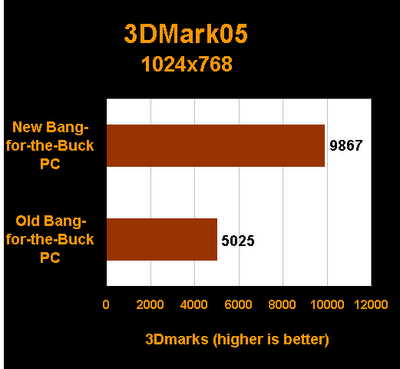
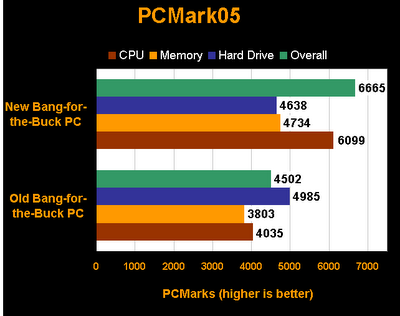
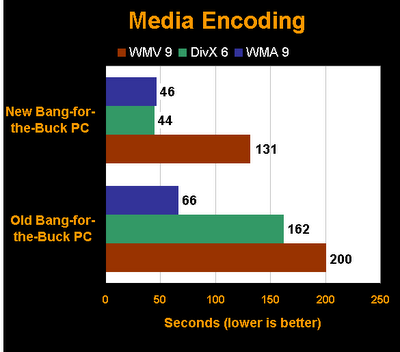
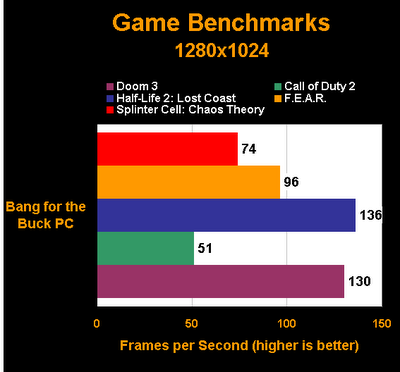
Best Bang for the Buck PC


STEREO spacecraft to view sun in 3D

The STEREO spacecraft is checked out at Astrotech Space Operations in Titusville¸ Fla. in preparation for planned Aug. 31 flight on a Boeing Delta II rocket.

Boeing, working with NASA, hosted 10 media organizations as they viewed the Solar Terrestrial Relations Observatory (STEREO) spacecraft Friday preceding its fueling and encapsulation at the Astrotech Space Operations facility. STEREO is set to launch on a Boeing Delta II rocket from Space Launch Complex 17-B at 3:12 p.m. EST Sunday, Aug. 31, from Space Launch Complex 17-B at Cape Canaveral Air Force Station, Fla.

Once in space, STEREO will divide into two spacecraft whose primary mission is to provide the first ever 3-D "stereo" images of the Sun by observing the same area from two different locations. STEREO will study how coronal mass ejections affect the Earth, its atmosphere and space weather.

During the two-year mission, the twin space-based observatories will explore the origin, evolution and interplanetary consequences of coronal mass ejections, the most intense explosions in our solar system. When directed at Earth, these powerful eruptions affect satellite operations, radio communications and power systems.

In addition, the forces related to the solar eruptions are hazardous to scientific spacecraft and astronauts. This is especially important information to learn for astronauts who will one day make a trip to Mars.

The STEREO mission will be the 318th launch in the history of Boeing’s Delta program. Boeing Delta IIs have carried payloads into orbit both for government and commercial customers, including NASA, the U.S. Air Force and the National Reconnaissance Office as well as a variety of commercial customers.